
Running a fitness studio means managing more than great classes, motivated members, and skilled trainers. Every membership payment, drop-in class, personal training package, retail sale, event registration, and online booking depends on a payment system that works smoothly without eating too much of your revenue.
That is why low-cost credit card processing for fitness studios matters. Fitness businesses often rely on predictable monthly income, but even small differences in credit card processing fees can add up across memberships, renewals, class packs, and merchandise purchases.
The right setup helps studios accept cards, ACH, online payments, and recurring billing while keeping costs manageable. It also reduces manual admin work, improves cash flow, and gives members the convenient payment experience they expect.
For studios that sell memberships, class bundles, nutrition products, branded apparel, workshops, and personal training, payment processing is not just a back-office task. It directly affects margins, member satisfaction, and long-term growth.
A smart strategy combines transparent pricing, secure systems, automation, ACH options, clear billing policies, and regular statement reviews. The goal is not simply to find the cheapest rate. The goal is to choose budget-friendly payment solutions for fitness centers that support the way the business actually operates.
What Is Low-Cost Credit Card Processing for Fitness Studios?
Low-cost credit card processing for fitness studios refers to a payment setup that allows a studio to accept member payments affordably, securely, and efficiently. It usually includes credit cards, debit cards, ACH bank payments, recurring billing, online invoices, mobile payments, payment links, and point-of-sale tools.
For a fitness studio, the payment system needs to do more than process a one-time sale. Studios often manage memberships, class packs, private training sessions, workshops, retail purchases, cancellation requests, frozen memberships, failed payments, and plan changes.
A low-cost system should support these needs without forcing the business into expensive add-ons that do not create value.
Fitness studio payment processing usually includes a merchant account or payment processor, a gateway for online transactions, billing software, and a way to store payment credentials securely for future billing.
For example, a yoga studio may need online payments for fitness studios so members can book classes through the website. A boxing gym may need recurring billing for fitness studios so monthly memberships run automatically. A personal training studio may need mobile card acceptance for in-person package sales.
Affordable payment processing for gyms is not only about the advertised percentage rate. The total cost includes transaction rates, fixed per-transaction fees, monthly fees, gateway charges, statement fees, batch fees, chargeback fees, PCI-related costs, software fees, and the time staff spend fixing billing issues.
A strong setup may include:
- Credit and debit card acceptance
- ACH payments for gyms
- Recurring membership billing
- Online invoices and payment links
- Secure card-on-file billing
- Mobile and in-studio checkout
- Member self-service portals
- Automated failed-payment reminders
- Reporting and reconciliation tools
Pro Tip: The lowest advertised rate is not always the lowest total cost. Compare the full monthly cost based on your actual payment volume, average ticket size, membership mix, and online transaction percentage.
For many studios, the best approach is a blended strategy. Use cards when convenience matters most, offer ACH for recurring memberships, automate billing reminders, and review statements regularly. This helps balance member experience with cost control.
Helpful internal resource: studios exploring bank payment options can review this guide to setting up ACH payment processing for a fitness business.
Why Processing Costs Matter for Fitness Studios
Processing costs matter because fitness studios often operate with tight margins and recurring revenue patterns. Rent, instructor pay, software subscriptions, utilities, equipment, insurance, cleaning, marketing, and repairs can already consume a large share of monthly revenue.
Payment costs may seem small per transaction, but they become significant when applied to every membership, package, and retail sale.
For example, a studio with many recurring members may process hundreds or thousands of monthly fitness membership payments. If the effective processing cost is higher than expected, the studio may lose meaningful revenue without noticing it immediately. This is especially true when fees are spread across multiple line items on a merchant statement.
Low-cost credit card processing for fitness studios helps protect profit margins. It also gives owners more flexibility when pricing memberships, offering class packages, running promotions, and selling retail items. When payment costs are predictable, it becomes easier to forecast cash flow and make smarter business decisions.
Affordable gym payment processing can also support member retention. Members want convenient payment options, but studios need those options to be sustainable.
If a payment system causes failed billing, unclear charges, or delayed updates, members may become frustrated. Poor billing experiences can lead to cancellations, disputes, and chargebacks.
Payment costs affect several areas of the business:
| Cost Area | What It Means | How Studios Can Reduce It |
| Transaction fees | Percentage and fixed fees charged on each card or online payment | Compare pricing models, encourage ACH for memberships, reduce manual entry |
| Monthly fees | Processor, gateway, software, reporting, or statement charges | Review statements, avoid duplicate tools, choose needed features only |
| Online payment costs | Higher costs for card-not-present transactions | Use secure payment links, require accurate billing information, reduce keyed entry |
| Chargeback fees | Fees and lost revenue from member disputes | Use clear policies, billing reminders, signed agreements, and detailed receipts |
| Failed payment costs | Admin time and delayed cash flow from declined cards | Use card updater tools, payment retries, and automated reminders |
| Compliance costs | Security-related fees and workflow requirements | Use tokenization, hosted payment pages, and PCI-aware systems |
| Admin labor | Staff time spent tracking payments manually | Use payment automation and recurring billing reports |
Credit Card Processing Fees
Credit card processing fees are usually made up of a percentage of the transaction plus a fixed fee. A studio may see fees vary depending on whether the payment is made in person, online, through a stored card, or manually keyed by staff.
Card type can also affect cost because premium rewards cards, commercial cards, and card-not-present payments often carry higher underlying costs.
For fitness studios, this matters because not all payments happen at the front desk. A member may sign up online, purchase a class package through a booking system, pay for personal training through a saved card, or buy merchandise in person. Each payment channel may carry a different cost.
Credit card processing fees also depend on the pricing model. Some providers use flat-rate pricing, which is easy to understand but may cost more at higher volume. Others use interchange-plus pricing, which separates card network costs from processor markup. Tiered pricing may group transactions into categories, but it can be harder to audit.
Studios should also pay attention to fixed fees. A fixed fee may seem minor, but it can affect lower-ticket items like single class purchases, bottled drinks, grip socks, or small retail items. If the studio sells many low-dollar items, the per-transaction fee becomes more important.
Monthly and Software Fees
Monthly and software fees can quietly increase the real cost of fitness studio payment processing.
A studio may pay for a merchant account, payment gateway, billing platform, point-of-sale system, reporting dashboard, customer database, scheduling software, or membership management tool. If these systems overlap, the studio may pay for duplicate features.
For example, a studio might pay one platform for class scheduling, another for recurring billing, another for online invoices, and another for reporting.
Even if each tool seems affordable on its own, the combined monthly cost may be higher than expected. Budget-friendly payment solutions for fitness centers should reduce complexity, not add unnecessary layers.
Gateway fees are common for online payments. They may be charged monthly, per transaction, or both. POS fees may apply for terminals, card readers, mobile devices, or software licenses. Some providers also charge statement fees, batch fees, account maintenance fees, or PCI-related fees.
Studios should review whether each monthly fee supports a real business need. A boutique pilates studio may need recurring billing and online booking but not a complex retail inventory system. A larger gym may need stronger reporting, multiple user permissions, and more detailed reconciliation.
Chargeback and Dispute Costs
Chargebacks can be expensive for fitness studios because they often involve both direct fees and lost revenue. A chargeback happens when a member disputes a payment with their card issuer.
In fitness businesses, disputes may arise from cancellation confusion, membership freezes, unclear renewal terms, missed billing notices, or dissatisfaction with services.
Chargebacks can affect low-cost credit card processing for fitness studios because excessive disputes may increase risk, create extra administrative work, and lead to higher processing costs.
Even when a studio wins a dispute, staff still spend time gathering agreements, receipts, communication records, attendance logs, and cancellation policy documents.
Many chargebacks are preventable. Studios should make billing terms clear at sign-up, send confirmation emails, provide receipts, explain cancellation deadlines, and make recurring charges recognizable on card statements. The billing descriptor should be easy for members to identify.
Failed billing communication can also lead to disputes. If a member does not understand why they were charged after a freeze, cancellation request, or package expiration, they may dispute the charge instead of contacting the studio. Clear documentation helps reduce this risk.
Best Payment Methods for Lower Costs

The best payment methods for lower costs usually combine convenience, flexibility, and smart routing. Fitness studios should not rely on one payment method for every situation. Instead, they should match the payment method to the transaction type.
Credit and debit cards are convenient for drop-ins, online bookings, retail items, workshops, and first-time member purchases. ACH payments for gyms can be useful for recurring memberships, larger training packages, and predictable monthly billing.
Payment links and online invoices can help with private training, events, special programs, and remote payments. Mobile wallets may improve checkout speed for retail and walk-in transactions.
Affordable payment processing for gyms often starts with giving members options. Some members prefer cards because of rewards or convenience. Others may be comfortable using bank payments for recurring dues. Studios can encourage lower-cost methods without making checkout difficult.
For recurring billing, ACH can often reduce costs compared with card payments, especially when billing larger monthly membership amounts. However, card payments may still be important because they are familiar and fast.
A balanced system allows studios to use ACH where it makes sense while still accepting cards for member convenience.
Payment methods to consider include:
- Credit cards for convenience and online booking
- Debit cards for lower-risk everyday payments
- ACH bank drafts for recurring dues
- Payment links for remote or custom payments
- Online invoices for private sessions or packages
- Mobile wallets for faster in-person checkout
- Stored payment credentials for recurring billing
- POS payments for retail and front-desk purchases
Helpful internal resource: studios comparing recurring billing tools can review this guide on automating billing and recurring payments for gym memberships.
ACH Payments for Membership Billing
ACH payments can be especially useful for recurring billing for fitness studios because they move funds directly between bank accounts. For monthly memberships, family plans, annual contracts, and larger class packages, ACH may offer a lower-cost alternative to card payments.
ACH payments for gyms can also improve predictability. Members can authorize recurring bank drafts, and the studio can collect dues on a set schedule. This reduces the need for staff to manually request payments each month. It can also reduce the number of expired-card issues because bank accounts do not expire the same way payment cards do.
That said, ACH is not perfect for every situation. Bank payments may take longer to settle than some card transactions. Returns can still happen if an account has insufficient funds, incorrect details, or revoked authorization. Studios need clear authorization language, secure storage, and reliable reporting.
ACH works best when paired with member communication. Members should understand when payments will be drafted, how cancellations work, and how they can update account details. Clear receipts and billing reminders help prevent confusion.
Card Payments for Convenience
Card payments remain essential for fitness studios because members expect fast, flexible checkout. Credit and debit cards make it easy to book online, reserve classes, buy drop-in passes, purchase retail items, pay for training packages, and register for events.
Even when a studio wants to reduce payment costs, eliminating cards can create friction. Members may abandon online checkout if their preferred payment method is not available. Walk-in customers may also expect to tap, swipe, dip, or use a mobile wallet without delay.
Card payments are especially important for online payments for fitness studios. Many bookings happen outside front-desk hours. A member may buy a class pack late at night, register for a morning session, or purchase a workshop from a mobile device. Card acceptance supports these habits.
The key is to process card payments efficiently. Studios should avoid unnecessary manual entry, use secure payment pages, collect accurate billing details, and keep stored cards updated. These steps can reduce failed payments and lower dispute risk.
How to Compare Cheap Merchant Accounts for Fitness Studios
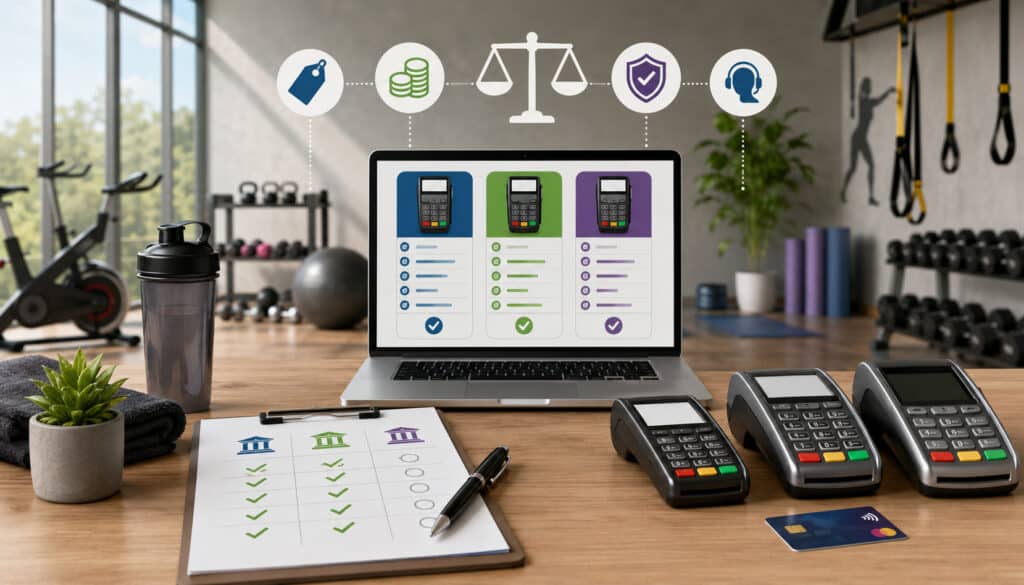
Comparing cheap merchant accounts for fitness studios requires looking beyond the headline rate. A provider may advertise low pricing but charge extra for gateways, statements, PCI programs, batch processing, online payments, chargebacks, or cancellation. The better question is: what will the total monthly cost be for your actual payment mix?
Start by identifying how your studio accepts payments. Do most members pay monthly? Do you sell class packs online? Do you process many in-person retail sales? Do you offer personal training packages? Do you need recurring billing, ACH, online invoices, mobile payments, and POS tools? Your business model should shape the payment setup.
Next, compare pricing models. Flat-rate pricing is simple and predictable. Interchange-plus pricing may offer more transparency and potential savings at scale. Tiered pricing can be harder to evaluate because transactions are grouped into broad categories. Whatever model you choose, ask for a sample statement and a full fee schedule.
Contract terms also matter. Some merchant accounts include early termination fees, long contracts, equipment leases, or volume commitments. A low rate may not be worthwhile if the agreement is restrictive. Look for transparent terms, clear support channels, and pricing that matches your growth plans.
Settlement timing is another important factor. Studios need predictable deposits to manage payroll, rent, instructor payments, and operating costs. Delayed settlement can create cash flow pressure even when sales are strong.
Integrations should also be considered. If the processor does not work with your scheduling software, membership system, website, or accounting workflow, staff may spend more time reconciling transactions manually. That labor cost can erase rate savings.
When comparing options, review:
- Effective rate based on actual monthly volume
- Card-present and card-not-present pricing
- ACH pricing and return fees
- Recurring billing capabilities
- Gateway and software fees
- Chargeback fees and dispute tools
- Contract length and cancellation terms
- Deposit timing
- Support availability
- Integration with booking and membership tools
- Reporting and reconciliation features
- Security tools such as tokenization
Helpful internal resource: new studios can use this merchant services setup guide for gyms to understand the tools usually needed before choosing a provider.
Using Payment Automation to Reduce Admin Costs
Payment automation can reduce costs by saving staff time, improving cash flow, and preventing avoidable billing problems. For fitness studios, admin labor is a real expense. Every manually processed payment, failed card follow-up, invoice reminder, refund request, and reconciliation task takes time away from member service and growth.
Automated billing helps studios collect recurring membership payments on schedule. Instead of manually charging each member, the system runs payments based on stored authorization and billing rules. This supports predictable revenue and reduces missed payments.
Card updater tools can also help. Cards expire, get replaced, or change after loss or fraud. When stored card details become outdated, recurring billing fails. A card updater can refresh eligible card information automatically, reducing declines and staff follow-up.
Failed payment recovery is another important feature. A good system can retry payments, send reminders, notify members, and provide secure update links. This helps recover revenue without requiring staff to call or email every member manually.
Member portals can reduce admin workload too. Members can update payment methods, review invoices, manage billing details, and see receipts without contacting the front desk. This improves transparency and reduces billing confusion.
Payment automation can support:
- Recurring membership billing
- Automated invoice delivery
- Failed payment reminders
- Secure payment update links
- Card updater tools
- Payment retry schedules
- Member self-service portals
- Billing reports
- Reconciliation exports
- Renewal reminders
- Package expiration notices
Automation also supports better reporting. Owners can track failed payments, upcoming renewals, outstanding balances, chargebacks, refunds, and revenue by payment type. These reports help identify preventable losses.
Payment Security and Compliance Best Practices
Payment security is essential for every fitness studio that accepts cards, stores payment credentials, or bills members automatically. Members trust studios with sensitive payment data, and weak handling practices can create financial, operational, and reputational risk.
Secure fitness studio payment processing should include encryption, tokenization, PCI-aware workflows, strong user permissions, refund controls, and secure card-on-file storage. The goal is to reduce exposure to sensitive card data while still allowing convenient billing.
Tokenization is especially important for recurring billing. Instead of storing the full card number in the studio’s system, the payment processor stores a token that can be used for future transactions. This helps reduce risk if the studio’s software account is compromised.
Studios should avoid writing card numbers on paper, storing them in spreadsheets, saving them in email, or entering them into unsecured notes. Manual card storage creates unnecessary risk and can complicate compliance.
User permissions matter too. Not every employee needs access to refunds, reports, stored payment profiles, or billing settings. Front-desk staff may need checkout access, while managers may need refund approval and reporting permissions. Limiting access reduces mistakes and misuse.
Refund controls are also important. Studios should document who can issue refunds, when refunds are allowed, and how refunds should be recorded. This protects both the business and the member relationship.
External informational resource: for background on card data security expectations, review this overview of PCI compliance.
Security best practices include:
- Use encrypted payment terminals
- Use tokenized card-on-file storage
- Avoid storing full card numbers manually
- Use hosted payment pages when possible
- Require strong passwords and account permissions
- Limit refund access to authorized users
- Keep software and devices updated
- Review user access regularly
- Send receipts and billing confirmations
- Maintain clear cancellation and refund records
Common Mistakes Fitness Studios Should Avoid
One common mistake is choosing a processor based only on the lowest advertised rate. A rate may look attractive but exclude gateway fees, monthly minimums, PCI-related fees, statement charges, batch fees, chargeback fees, or software costs. Studios should compare the total cost, not one number.
Another mistake is ignoring recurring billing needs. A general payment processor may work for basic retail sales but struggle with memberships, freezes, prorated charges, class packs, failed billing, and member portals. Fitness membership payments require tools designed for recurring revenue.
Weak cancellation policies can also lead to unnecessary disputes. If members do not understand notice periods, renewal terms, freeze rules, or refund limits, they may dispute charges. Policies should be visible during sign-up, included in agreements, and confirmed by email.
Manual card storage is a serious mistake. Writing down card numbers or saving them in spreadsheets creates security risk. Studios should use secure tokenized storage through a compliant payment system.
Poor reconciliation is another issue. If staff do not match deposits to sales, refunds, chargebacks, and fees, owners may not notice missing revenue or rising costs. Reconciliation should be part of the weekly financial routine.
Studios should also avoid failing to review statements. Credit card processing fees can change, and new fees may appear over time. Reviewing statements helps identify unexpected charges and compare actual costs with quoted pricing.
Common mistakes include:
- Choosing based only on advertised rates
- Ignoring ACH options
- Using tools that do not support recurring billing
- Storing card details manually
- Having unclear cancellation terms
- Not sending receipts or reminders
- Failing to monitor chargebacks
- Not reviewing merchant statements
- Using too many disconnected platforms
- Giving too many staff members refund access
Best Practices for Budget-Friendly Fitness Payment Processing

Budget-friendly payment solutions for fitness centers work best when the studio combines cost control with member convenience. The goal is to reduce unnecessary fees without creating friction at checkout or during membership billing.
Start by offering ACH for recurring memberships. ACH may be a good fit for monthly dues, long-term memberships, and larger training packages. It can reduce reliance on higher-cost card payments while still supporting predictable billing.
Next, keep credit and debit cards available. Members expect convenient payment options, especially for online booking, drop-ins, retail items, and short-term packages. Removing cards entirely can hurt conversions and member experience.
Review merchant statements regularly. Look at total fees, effective rate, monthly charges, chargeback fees, gateway fees, and unexpected line items. If fees increase or the statement becomes unclear, ask for an explanation.
Reduce manual entry whenever possible. Keyed transactions may cost more and carry higher risk. Use payment links, hosted checkout pages, chip readers, tap-to-pay devices, and stored payment profiles instead.
Document billing policies clearly. Membership agreements should explain billing dates, cancellation deadlines, freeze rules, renewal terms, refund policies, and failed payment procedures. Clear documentation helps prevent confusion and supports dispute responses.
Monitor chargebacks closely. Track why they happen and fix the root cause. If disputes are tied to cancellation confusion, improve cancellation communication. If disputes are tied to billing descriptors, update the descriptor. If disputes are tied to failed reminders, automate notifications.
Use reporting to improve decisions. Review revenue by payment method, failed payment trends, ACH returns, card declines, refunds, chargebacks, and outstanding balances. These insights can reveal where costs are increasing.
Best practices include:
- Offer ACH for recurring memberships
- Keep card payments available for convenience
- Use automated recurring billing
- Send billing reminders before charges
- Use secure payment update links
- Review statements monthly
- Track effective processing rate
- Reduce keyed transactions
- Use tokenized card storage
- Maintain clear billing agreements
- Monitor chargebacks and disputes
- Reconcile deposits with reports
- Limit refund permissions
- Compare total cost, not just rates
Helpful internal resource: studios building a stronger payment system can review this guide to payment processing infrastructure for fitness businesses.
What is low-cost credit card processing for fitness studios?
Low-cost credit card processing for fitness studios is a payment setup that helps studios accept member payments while keeping fees manageable. It may include credit cards, debit cards, ACH, recurring billing, online invoices, mobile payments, and POS tools.
The goal is not just to find the cheapest rate. A good setup should reduce total cost, support secure recurring billing, improve cash flow, and make payments convenient for members.
How can fitness studios reduce processing fees?
Fitness studios can reduce fees by reviewing merchant statements, comparing pricing models, reducing manual card entry, offering ACH for recurring memberships, using payment automation, and avoiding unnecessary software fees.
Studios should also monitor chargebacks, improve billing communication, and use secure online payment tools. Preventing avoidable disputes and failed payments can lower the overall cost of accepting payments.
Are ACH payments cheaper for gyms?
ACH payments can be more cost-effective for recurring membership billing and larger package payments. They are often useful for predictable monthly dues because they do not rely on expiring card numbers.
However, ACH is not always the best fit for every purchase. Cards may still be better for drop-ins, online bookings, retail sales, and members who prefer card rewards or faster checkout.
What fees should fitness studios watch for?
Fitness studios should watch for transaction fees, fixed per-transaction fees, monthly account fees, gateway fees, software fees, PCI-related fees, batch fees, statement fees, chargeback fees, ACH return fees, and early termination fees.
The most useful number is often the effective rate. Divide total monthly processing fees by total processed volume to understand the true cost.
Can automated billing reduce costs?
Yes. Automated billing can reduce admin labor, improve collection consistency, and lower the time spent chasing failed payments. It can also support payment reminders, card updates, retries, and member self-service updates.
Automation works best when paired with clear policies and regular reporting. Studios should still review failed payments, disputes, refunds, and revenue reports.
How can studios reduce chargebacks?
Studios can reduce chargebacks by using clear membership agreements, recognizable billing descriptors, confirmation emails, payment receipts, cancellation documentation, and reminder notices.
They should also make cancellation and freeze policies easy to understand. When members know what to expect, they are less likely to dispute a valid charge.
Should fitness studios accept credit cards?
Yes, most fitness studios should accept credit cards because members expect convenient payment options. Cards are especially important for online booking, drop-ins, class packs, workshops, and retail purchases.
Studios can still control costs by offering ACH for recurring billing, reviewing statements, reducing manual entry, and using secure card-on-file tools.
What should studios compare before choosing payment processing?
Studios should compare total monthly cost, pricing model, contract terms, gateway fees, ACH options, recurring billing tools, software integrations, support quality, deposit timing, chargeback fees, and security features.
The best choice is usually the option that fits the studio’s payment workflow, not simply the one with the lowest advertised rate.
Conclusion
Low-cost credit card processing for fitness studios requires more than chasing the lowest rate. Studios need transparent pricing, smart payment methods, secure systems, reliable recurring billing, ACH options, automation, and clear billing policies.
The right setup supports memberships, drop-ins, personal training, class packs, online bookings, and retail sales without creating unnecessary costs or admin work.
By reviewing statements, offering ACH, reducing manual entry, automating reminders, monitoring chargebacks, and protecting member payment data, fitness studios can build a payment system that is both affordable and dependable.
A practical payment strategy helps protect margins, improve cash flow, and create a smoother experience for members. For fitness businesses built on recurring relationships, that combination is essential.