
By admin March 11, 2026
Running a fitness business is about much more than helping members reach their goals. Behind every monthly membership, personal training package, drop-in class, smoothie purchase, and online booking is a payment system that needs to work smoothly, consistently, and securely. That is why payment processing infrastructure for fitness businesses matters so much.
For gyms, fitness studios, yoga studios, martial arts schools, personal training facilities, and boutique concepts, payments are not a one-time event. They are ongoing relationships. Members expect billing to be accurate, sign-up to be easy, and checkout to feel fast whether they are paying in person, online, or through a mobile device.
Owners and managers need a system that supports recurring revenue, reduces missed payments, keeps front desk operations moving, and gives them clear visibility into cash flow.
A weak setup can create daily friction. Failed recurring charges, disconnected software, manual follow-up, chargebacks, cancellation confusion, and limited reporting can all drain time and hurt member trust.
A strong setup does the opposite. It helps fitness businesses automate routine billing tasks, support more payment methods, connect scheduling with checkout, and create a better member experience from sign-up through renewal.
This guide explains what payment processing infrastructure means in a fitness setting, how the main parts work together, and what features actually matter when choosing a system.
You will learn how fitness business payment systems support memberships, subscriptions, classes, training sessions, retail sales, and online payments, along with practical tips for building an infrastructure that can grow with your operation.
What Payment Processing Infrastructure Means for Fitness Businesses
Payment processing infrastructure for fitness businesses is the complete system that allows a gym or studio to accept, manage, track, and reconcile payments across all the ways members buy from the business.
It is not just a card terminal at the front desk. It includes the merchant account, payment processor, payment gateway, point-of-sale tools, billing automation, scheduling integrations, member profiles, reporting, and the workflows that connect them.
In a fitness environment, this infrastructure needs to support a unique mix of transactions. A member may join online, sign a recurring membership agreement, book classes through an app, pay for personal training sessions, buy branded apparel at the counter, and update a card on file six months later.
Those are different transaction types, but to the member they should feel like one connected experience. That is what strong infrastructure makes possible.
Fitness industry payment processing also has to manage more than the payment itself. It often needs to handle recurring billing cycles, failed payment recovery, prorated charges, freezes, plan upgrades, family memberships, and cancellation workflows.
Many general business payment tools can accept a card, but that does not mean they are built for the way fitness businesses actually operate.
When owners hear the phrase payment processing for fitness businesses, they often think about rates first. Pricing matters, but it is only one part of the decision. Reliability, automation, integrations, ease of use, and billing controls can have just as much impact on revenue and operations.
Why fitness businesses need specialized payment workflows
Fitness businesses do not behave like standard retail stores. A clothing shop may complete a sale and move on. A gym or studio often starts a long-term billing relationship with the member. That difference changes what the payment system must handle on a daily basis.
For example, recurring billing for gyms needs to process scheduled membership dues without forcing staff to manually charge cards every month. A fitness membership payment system may also need to apply enrollment fees, annual fees, package credits, late fees, guest passes, or class-specific pricing.
Boutique studios may rely heavily on class packs and subscriptions, while larger gyms may have tiered memberships, add-on services, and retail products under the same account.
That means the infrastructure must support account-level logic, not just isolated transactions. It has to know who the member is, what they purchased, when they should be billed, and what should happen if their payment method fails. It also needs to connect those billing rules to access, booking, and communication systems.
This is why purpose-built payment solutions for gyms and fitness studios tend to outperform generic tools. They are designed around recurring relationships, operational complexity, and member experience. A studio can survive for a while with a patchwork setup, but growth usually exposes the limits of disconnected systems.
How payment infrastructure affects member experience and retention
Members may not think about infrastructure directly, but they feel its impact all the time. If online checkout is clunky, joining becomes harder. If billing errors are common, trust drops. If updating a card on file takes too long, accounts lapse. If booking and payment are disconnected, members get frustrated before class even begins.
On the other hand, a smooth system creates confidence. Members can sign up online, store a preferred payment method, receive clear billing confirmations, book services easily, and manage their account without unnecessary back-and-forth. That experience matters because convenience plays a major role in retention.
The front desk also benefits. Staff spend less time troubleshooting payments and more time helping members. Managers gain better visibility into recurring revenue and outstanding balances. Owners can make decisions based on clear reporting instead of assumptions.
In practical terms, gym payment processing systems influence much more than collections. They shape the entire financial relationship between the business and the member.
When the system works well, it supports trust, consistency, and growth. When it does not, even strong programming and great coaching can be overshadowed by preventable payment friction.
Core Components of a Fitness Payment System
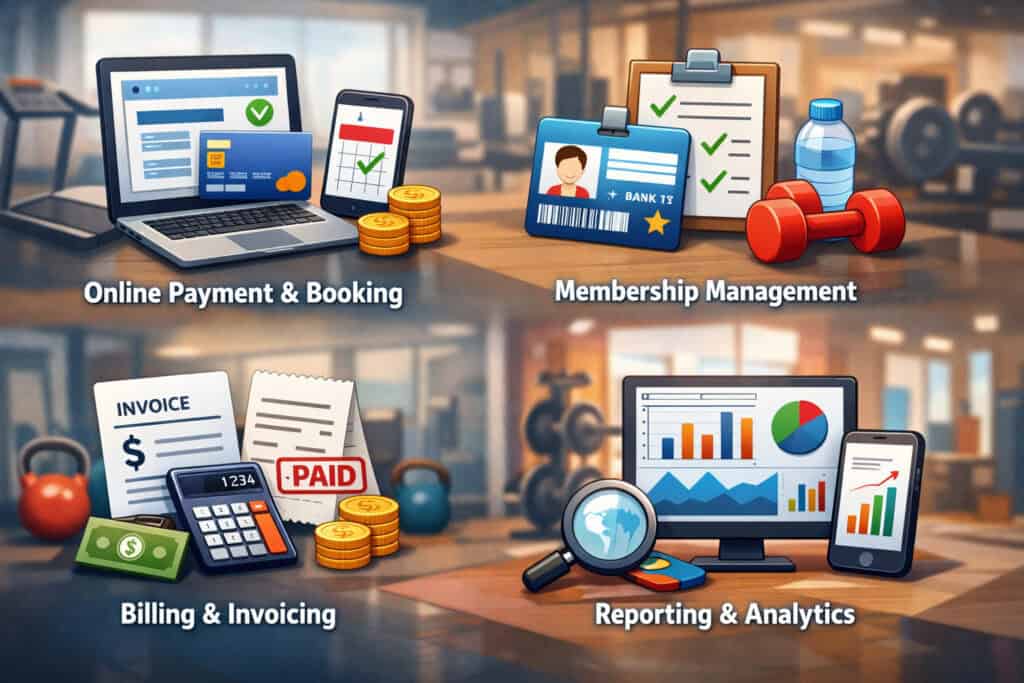
A complete payment setup for a gym or studio usually includes several moving parts. Each serves a different purpose, but they need to work together as one system. When owners evaluate payment processing for fitness businesses, it helps to break the infrastructure into its core components instead of looking at it as one vague software category.
At the foundation is the merchant account, which allows the business to accept card payments and receive funds. Connected to that is the payment processor, which handles the transaction itself by moving payment information through the networks involved in approval and settlement.
Then there is the payment gateway, which securely sends payment data from online checkout forms, mobile apps, or software platforms to the processor.
On the operational side, many fitness businesses also rely on POS systems for gyms, front-desk hardware, online booking tools, membership billing software, mobile payment devices, and reporting dashboards. Some businesses use one platform that includes most of these features. Others connect several tools through integrations.
The goal is not necessarily to have the most features. It is to create a system that matches the business model. A high-volume gym with memberships, retail, child programs, and training packages may need a more advanced setup than a small appointment-based studio. But both need reliable infrastructure that reduces friction.
The strongest fitness business payment systems centralize payment records, member account data, and billing activity so staff can quickly understand what has been paid, what is due, and what action is needed.
When these components are disconnected, the business often ends up doing manual reconciliation, chasing members for updated cards, or trying to solve billing issues without a clear record.
Merchant accounts, processors, and gateways
These terms are often grouped together, but they are not the same thing. The merchant account is the account that lets a business accept card payments and receive the funds after transactions settle.
The payment processor is the service that handles the authorization and transmission of transaction data. The payment gateway is the secure technology layer used to collect and send payment details from online or software-based checkout environments.
For fitness businesses, this distinction matters because each part affects reliability and flexibility. Some platforms bundle them into one service, which can simplify onboarding and support. Others let businesses choose separate providers, which may offer more control but can add complexity.
A gym that sells memberships online needs a payment gateway for fitness studios or gyms that works with sign-up forms, stored cards, recurring billing, and account updates.
A front desk that checks in members and sells shakes or shirts needs card-present processing through compatible hardware. If the merchant account or processor is not designed to support the business model, approval issues, delays, or limited billing options may follow.
Owners should also look at how funds are deposited, how disputes are handled, and whether the platform supports both in-person and online transactions under one member record. That kind of visibility becomes increasingly important as the business adds new services, locations, or digital offerings.
POS systems, billing software, and mobile payment tools
POS systems for gyms do much more than ring up retail items. In many fitness businesses, the point-of-sale environment is tied to member profiles, saved payment methods, package balances, staff permissions, and appointment or class scheduling. A good POS setup helps staff move quickly while keeping payment records organized.
Gym membership billing software plays a different but equally important role. It manages recurring dues, billing dates, autopay rules, failed payment attempts, account freezes, membership changes, and notifications.
This software is often the engine behind subscription billing for fitness studios and monthly gym memberships. Without it, staff may need to process recurring charges manually or use workarounds that do not scale well.
Mobile payment tools add flexibility. Trainers may want to collect a payment on the gym floor, at an off-site bootcamp, or during a community event.
Studio owners may need contactless checkout during busy class transitions. Mobile tools also support digital-first experiences where staff members are not always stationed behind a traditional front desk.
When these components work together, the result is a more complete fitness business payment system. The business can process new sign-ups, recurring billing, retail sales, and mobile checkout through a connected infrastructure.
That reduces duplicate data entry, improves reporting, and makes it easier to understand each member’s financial relationship with the business.
How Gyms and Studios Handle Memberships and Recurring Payments

Memberships are the financial backbone of many fitness businesses. Whether the model is built around full-access gym memberships, class-based subscriptions, limited-session plans, or coaching retainers, recurring revenue usually provides the stability needed to forecast cash flow and plan growth. That is why recurring billing for gyms is one of the most important parts of payment infrastructure.
A recurring payment model sounds simple on the surface: charge a member on a set schedule. In practice, it involves many decisions. Businesses need to choose billing frequency, determine when to charge, handle prorated starts, manage plan changes, and store payment credentials securely for future use.
They also need a process for communicating payment issues, handling retries, and defining what happens when a member freezes, cancels, or falls behind.
Fitness membership payment systems help automate those tasks so staff do not have to track every account by hand. This matters because even a modest gym can have hundreds of active billing relationships at once. Manual processes become difficult to maintain quickly, and mistakes in recurring billing can damage trust faster than almost anything else.
Studios and gyms also have different models. A traditional gym may focus on monthly or annual membership dues. A yoga studio may combine memberships with class packs. A martial arts school may bill family plans and rank-related fees.
A personal training facility may collect recurring payments for coaching packages plus one-off charges for additional services. Good infrastructure supports all of those scenarios without forcing the business into a rigid structure that does not fit.
Automated payment systems should do more than run charges. They should help businesses manage the entire member billing lifecycle with less manual intervention and fewer avoidable errors.
Subscription billing, autopay, and member lifecycle management
Subscription billing for fitness studios and gyms works best when it is tied to the member lifecycle rather than treated as a standalone payment tool. That means the system should support sign-up, onboarding, active billing, upgrades, freezes, renewals, and cancellation handling within the same account structure.
Autopay is central to that process. Most members expect recurring dues to run automatically using a card on file or another saved payment method. For the business, autopay creates predictable collections and reduces the burden of chasing payments. For members, it removes the need to remember monthly due dates.
But the real value comes from the rules around autopay. The system should be able to schedule charges correctly, retry failed payments, notify members when action is needed, and show staff a clear status for each account.
It should also make it easy for members to update payment methods, review billing history, and understand what they are paying for.
Lifecycle management matters because memberships change over time. Some members upgrade. Some pause temporarily. Some cancel and later return. A flexible system should support those changes without creating duplicate accounts, billing confusion, or inconsistent records.
Handling classes, training sessions, packages, and drop-ins
Not every fitness transaction is recurring. Many businesses also rely on drop-in class payments, class packs, personal training sessions, small group training packages, workshops, and retail sales.
A complete payment processing infrastructure for fitness businesses needs to handle both recurring revenue and one-time payments without forcing staff to use separate systems.
For class-based studios, online booking and payment should be closely connected. Members may reserve a class through an app or website, and the system needs to know whether that booking draws from a package, is included in a membership, or requires a one-time payment.
If payment and scheduling are disconnected, the studio risks confusion at check-in and extra admin work behind the scenes.
The same is true for training sessions. A trainer may sell a package of sessions, bill monthly for coaching, or charge individually after each appointment. The best fitness business payment systems can track package balances, attach payments to services, and support automatic checkout when appropriate.
Drop-in purchases add another layer. A business should be able to accept fast in-person and online payments without creating friction for new or occasional customers. That matters for trial visits, guest passes, workshops, and special events.
When recurring and non-recurring payments live inside the same member profile, the business gets a cleaner view of revenue and member behavior. That makes reporting stronger and creates a more consistent customer experience across the entire operation.
Payment Methods Fitness Businesses Should Support

Members want flexibility. Some prefer cards on file for autopay. Others want to pay online before class. Some expect contactless checkout at the front desk. Businesses that support a narrow set of payment options can create unnecessary friction during sign-up and ongoing billing.
Modern payment solutions for gyms and fitness studios should support the main payment methods members already use in everyday life. For most fitness businesses, that includes credit cards, debit cards, digital wallets, ACH bank transfers, recurring stored payments, and online checkout for bookings or e-commerce purchases.
The right mix depends on the business model, but the overall goal is the same: make payment convenient without creating operational headaches.
Fitness industry payment processing also benefits from consistency across channels. If a member joins online, books through a mobile app, and buys products in person, their payment methods and billing records should ideally stay tied to one account. That makes account management easier for staff and gives members a more seamless experience.
Supporting more payment methods is not just about convenience. It can also improve collections. If a member’s card expires or fails, having an alternate payment option or an easy update process can help the business recover revenue faster.
For recurring billing businesses, even small improvements in payment method flexibility can reduce churn caused by avoidable billing failures.
At the same time, more options should not mean more confusion. The payment setup should guide members clearly through what is accepted, when payment is due, and how recurring charges work. Clarity is just as important as flexibility.
Cards, digital wallets, ACH, and online checkout
Credit card processing for gyms remains a core part of most payment setups because cards are fast, familiar, and well suited to both one-time and recurring charges. Debit cards are also widely used for memberships and class payments.
For many gyms and studios, cards will continue to be the default payment method for autopay and front-desk transactions.
Digital payments for fitness centers have expanded beyond cards alone. Contactless wallets can speed up checkout for retail items, drop-ins, and quick purchases. They can also make mobile-first experiences more appealing for tech-comfortable members who want fewer steps at checkout.
ACH bank transfers can be useful for recurring memberships, especially for businesses that want an alternative to cards on file. Some members prefer bank-based payments for recurring dues, and businesses may appreciate the different cost structure depending on the provider and billing model.
The key is to understand how ACH fits into the business’s operations, including timing, returns, and member support.
Online checkout is essential for digital sign-up, class registration, gift card purchases, virtual programs, and appointment booking. The checkout flow should be simple, mobile-friendly, and clearly connected to member records. If it takes too many steps or feels disconnected from the rest of the experience, conversion can suffer.
Matching payment methods to different fitness business models
Different fitness businesses have different payment needs, and the payment method mix should reflect that reality. A traditional membership gym may prioritize recurring card or ACH payments, plus in-person card acceptance for retail and add-ons.
A boutique studio that sells class packs may need a stronger online checkout experience and faster mobile booking payments. A martial arts school may want family billing support and flexible stored payment methods linked to parent accounts.
Personal training businesses often need to support recurring coaching payments alongside package sales and invoices for one-on-one services.
Hybrid fitness brands with virtual programming may need digital checkout, stored credentials, and online subscription support. Multi-location operations may need consistency across all channels and facilities so reporting stays accurate and member records stay unified.
This is why there is no single perfect answer for fitness business payment systems. The right setup depends on how the business earns revenue and how members interact with it. Owners should start by mapping the business model rather than shopping by price alone.
Key Features to Look for in a Gym Payment Processing System
Not every payment platform built for service businesses is a good fit for fitness. Gyms and studios have billing patterns, member management needs, and operational rhythms that require specific functionality.
When evaluating gym payment processing systems, owners should focus on features that improve collections, reduce manual work, and support member experience over time.
The most valuable features are often the ones that remove recurring friction. Automated billing reduces the need for staff intervention. Integrated scheduling prevents booking and payment confusion.
Member account management makes it easier to handle updates without long support exchanges. Reporting dashboards help owners understand revenue trends, failed payments, and retention risks before they become major problems.
Another important factor is flexibility. The platform should support multiple membership types, packages, one-time sales, and service add-ons without forcing awkward workarounds. It should also allow the business to adapt as its model evolves.
For example, a studio that begins with class packs may later add recurring memberships, retail sales, and online programs. Replacing infrastructure after growth can be expensive and disruptive, so scalability matters from the beginning.
Security and transparency matter too. Businesses need to know how payment data is stored, how disputes are handled, and how staff permissions are managed. They also need a clear understanding of processing terms, hardware compatibility, and integration options with existing fitness software.
A good system should feel like operational support, not another burden. If daily tasks require too many steps, training becomes harder and mistakes become more likely.
Automation, reminders, reporting, and cancellation handling
Payment automation for fitness businesses is one of the most practical features to prioritize because it directly affects collections and staff workload.
Automated recurring billing, payment reminders, card update prompts, and failed payment retries help businesses capture revenue with less manual effort. Instead of spending hours each month chasing declined transactions, staff can focus on member service and retention.
Automated reminders are especially helpful when accounts approach renewal dates, payment methods are close to expiring, or a failed charge needs member action. These communications should be timely, clear, and tied to the member account. A good system reduces guesswork for both the business and the customer.
Reporting dashboards matter because owners need more than a list of transactions. They need visibility into recurring revenue, delinquent accounts, payment recovery rates, package usage, refunds, chargebacks, and overall billing health. Strong reporting makes it easier to identify trends, improve processes, and forecast cash flow.
Cancellation handling is another area where weak systems create big problems. A fitness business should be able to document requests, apply the proper policy, stop or adjust recurring billing when appropriate, and keep a clean record of what happened.
Confusing cancellation workflows often lead to disputes and chargebacks. Clear cancellation handling protects both the business and the member relationship.
Integrations with scheduling, CRM, and fitness management platforms
For most fitness businesses, payment processing does not operate alone. It connects with scheduling, membership management, CRM tools, access control, communication platforms, and sometimes payroll or accounting software. That is why integration is one of the most important features to evaluate when choosing payment infrastructure.
If booking and billing are connected, members can reserve classes, pay balances, and manage packages more easily. Staff can see whether someone is paid before check-in. Trainers can track sessions against package usage. Front desk teams do not have to switch between multiple disconnected tools to understand what is happening.
CRM integrations matter because payment data often supports retention efforts. A business may want to identify members with past-due balances, trigger communication when packages run low, or segment active members by plan type. When payment and member relationship data work together, follow-up becomes more relevant and timely.
Fitness management platforms often bring many of these pieces together, but integration quality still varies. Some systems sync data in real time, while others rely on limited or delayed connections. Business owners should ask how member records, transactions, refunds, failed payments, and plan changes move between systems.
Common Payment Challenges in the Fitness Industry
Even well-run fitness businesses face payment challenges. The key difference is whether the infrastructure helps solve those issues quickly or makes them harder to manage. Because gyms and studios rely so heavily on recurring revenue, small billing problems can compound over time if they are not handled with clear processes and the right tools.
One of the most common issues is failed recurring payments. Cards expire, accounts change, and members forget to update their information. Without automated retries and reminders, those failures can create unnecessary revenue loss.
Another common issue is billing confusion around freezes, upgrades, cancellations, or prorated charges. If the system cannot apply rules consistently, staff may end up improvising, which increases the chance of mistakes.
Chargebacks and disputes are another challenge. A member may not recognize a charge, believe a cancellation was processed when it was not, or question a fee tied to a contract or policy they did not fully understand. Clear records, transparent communication, and strong account notes are essential here.
Outdated payment methods also create problems. If the business makes it difficult to update cards on file, members may lapse simply because the process is inconvenient. And when reporting is weak, owners may not realize how much revenue is being lost to avoidable billing friction.
The point is not to eliminate every problem. That is unrealistic. The goal is to build fitness payment processing systems that reduce frequency, improve recovery, and help staff respond consistently when issues arise.
Failed payments, chargebacks, and billing disputes
Failed payments are often treated as minor admin issues, but they can quietly become a major source of lost revenue.
In recurring billing environments, one failed charge may turn into weeks of missed collections if the system does not retry automatically or prompt the member to update their payment method. Good gym membership billing software should detect these failures quickly and launch a clear recovery workflow.
Chargebacks are more serious because they can cost both revenue and time. They often happen when members do not recognize a charge, believe they canceled, or dispute a service they think was not delivered as expected.
In many cases, the underlying problem is not fraud but poor communication, weak records, or inconsistent policy handling.
Billing disputes can also arise from unclear signup terms, difficult cancellation processes, or manual adjustments that were not properly documented. When staff cannot easily see a member’s billing history, contract terms, or payment attempts, resolving disputes becomes harder and slower.
To reduce these issues, fitness businesses need transparent receipts, clear membership terms, consistent cancellation procedures, and account-level visibility into billing events. Strong infrastructure creates a paper trail that protects both the member and the business when questions come up.
Membership changes, outdated payment methods, and manual processes
Fitness businesses are dynamic. Members upgrade plans, freeze accounts, return after canceling, add family members, buy extra services, or shift from class packs to recurring subscriptions. Payment systems need to handle those changes without forcing staff into complicated workarounds.
Outdated payment methods are a constant challenge in recurring billing. Cards expire, are replaced, or are temporarily locked. If the only update path requires a phone call or in-person visit, many members delay taking action.
That delay can lead to failed payments, service interruptions, and preventable churn. Self-service account management helps solve this by giving members a simple way to review and update payment details.
Manual processes create another layer of risk. Spreadsheets, handwritten notes, separate terminals, and disconnected booking systems may work when a business is small, but they often break down as volume grows.
Manual billing adjustments are easy to mishandle. Refunds can get lost in the shuffle. Reporting becomes unreliable because information lives in too many places.
This is why payment automation for fitness businesses is not just about convenience. It is about consistency, accuracy, and scale. The fewer manual patches a system relies on, the easier it is to manage memberships and protect revenue over time.
How to Choose the Right Payment Infrastructure for Your Fitness Business
Choosing payment processing infrastructure for fitness businesses is ultimately a business model decision. The right system for a high-volume gym will not necessarily be the right fit for a boutique Pilates studio, a martial arts school, or a trainer-led microgym.
Owners should start by understanding how money flows through the business today and how they want it to flow in the future.
First, map your revenue types. Do you primarily bill monthly memberships? Sell class packs? Collect package payments for personal training? Offer retail products, digital coaching, or special events?
The more varied your revenue streams, the more important it is to have a connected system that supports multiple transaction types under one member profile.
Next, consider operational complexity. A small studio with one location may prioritize simplicity and ease of use.
A growing gym with multiple staff roles, high transaction volume, and several service lines may need stronger permissions, reporting, and integration capabilities. The right infrastructure should match how your team actually works, not just what looks good in a product demo.
It is also worth thinking about member expectations. If your business relies heavily on app-based booking, recurring subscriptions, and digital engagement, online payments and self-service account features will carry more weight. If front-desk retail and in-person transactions are central, hardware and POS workflows matter more.
Cost matters, but it should be viewed in context. Processing rates, monthly software fees, hardware, setup support, integration costs, and operational efficiency all affect total value.
Evaluating fit based on size, model, and growth goals
A business with 100 active members and simple recurring dues may not need the same infrastructure as a business with thousands of members, multiple departments, and layered pricing rules. Scale affects not only volume but also the need for reporting, permissions, automation, and support.
For example, a yoga studio built around class packages and memberships may need strong scheduling integration, mobile booking payments, and package tracking.
A martial arts school may prioritize family billing, recurring tuition, and student account management. A full-service gym may need membership dues, personal training, retail, café sales, and access control all tied together.
Growth goals matter too. If you plan to open another location, add franchising support, launch online programming, or introduce new recurring offers, your system should be able to support those next steps. Replacing a payment system after expansion is usually more disruptive than choosing a flexible one earlier.
Owners should ask not only, “Can this system handle what we do now?” but also, “Will this system still fit when we add complexity?” A scalable setup reduces future migration stress and supports better continuity for both staff and members.
Questions to ask before choosing a provider
A thoughtful evaluation process can save a lot of frustration later. Before committing to a provider, fitness businesses should ask practical questions tied to real operations rather than general marketing promises.
Useful questions include:
- How does the platform handle recurring billing, freezes, upgrades, and cancellations?
- Can members update payment methods themselves?
- Does the system support both in-person and online transactions under one account?
- How are failed payments retried and communicated?
- What reporting is available for recurring revenue, declines, refunds, and disputes?
- Which scheduling, CRM, and fitness management tools does it integrate with?
- How are chargebacks handled?
- What support is available during setup and after launch?
- Are there contract terms, hardware limitations, or migration costs to know upfront?
Best Practices for Managing Payments and Memberships Efficiently
Even the best software will not solve every payment issue on its own. Fitness businesses also need clear internal processes. Good infrastructure works best when it is paired with thoughtful billing policies, staff training, and consistent communication.
Start with transparency. Members should understand pricing, billing frequency, renewal terms, cancellation policies, and what happens if a payment fails. Confusion at signup often turns into disputes later. Clear digital agreements, easy-to-read receipts, and consistent front-desk communication help prevent problems before they happen.
Next, prioritize account hygiene. Encourage members to keep payment methods current and make updates easy through self-service tools whenever possible. Staff should know how to review account status, explain balances, and resolve basic billing questions without escalating every issue.
Automation should be used strategically. Automated billing, reminders, and failed payment workflows can save a lot of time, but they should also be monitored. Managers should review delinquency trends, recovery success rates, and cancellation patterns regularly. Automation is most powerful when it is visible and measurable.
Integration discipline also matters. If you use multiple systems, confirm that transactions, bookings, memberships, and refunds sync accurately. Set a process for checking exceptions so small data issues do not turn into larger reporting or service problems.
Finally, treat payment experience as part of member experience. Fast checkout, easy booking, clear records, and responsive billing support all influence how members feel about the business. In a competitive market, convenience and trust can become real advantages.
Operational habits that improve collections and reduce friction
Small operational habits can make a major difference in how smoothly a fitness membership payment system performs. One of the most important is reviewing failed payments regularly rather than letting them sit. A delayed response can lead to larger balances, awkward member conversations, and a lower chance of recovery.
Another helpful habit is standardizing how staff explain billing terms. If every employee describes freezes, renewals, and cancellation rules differently, member confusion grows. Short internal scripts and training guidelines can keep communication consistent without sounding robotic.
It also helps to document exceptions carefully. Refunds, custom payment plans, temporary holds, and account notes should be recorded in the system, not just remembered by staff. When questions arise later, those notes can prevent disputes and save time.
Businesses should also review payment-related member touchpoints periodically. Test the online checkout flow. Try updating a card on file. Book a class through the member app. Visit the front desk as if you were a new customer. These simple checks often reveal friction points that staff have stopped noticing.
Building a payment infrastructure that supports long-term growth
A scalable payment setup should do more than handle today’s transactions. It should support the next version of the business. That might include more members, additional locations, new pricing models, online services, more staff roles, or expanded reporting needs.
To prepare for growth, centralize as much payment and member data as possible. Disconnected systems can seem manageable at first, but they create bottlenecks later when the business needs consistent reporting or cross-location visibility. Centralized records also make it easier to support members across channels.
It is also wise to build around adaptable workflows. Choose systems that let you add membership types, service categories, and payment methods without requiring a full rebuild. Flexibility matters because fitness businesses often evolve faster than expected.
Finally, revisit infrastructure decisions periodically. What worked at one stage may not be the best fit later. As the business grows, payment infrastructure should be reviewed with the same seriousness as staffing, programming, and marketing. Reliable payment operations are not just a back-office concern. They are part of what makes sustainable growth possible.
Frequently Asked Questions
Q.1: What is payment processing infrastructure for fitness businesses?
Answer: Payment processing infrastructure for fitness businesses is the full system used to accept, manage, and track member payments. It includes the merchant account, payment processor, payment gateway, billing software, POS tools, online checkout, and any integrations with scheduling or fitness management platforms.
In practice, it supports recurring memberships, class payments, training packages, retail sales, and digital transactions. The goal is to create a connected process that makes payments easier for members and easier to manage for the business.
Q.2: Why is recurring billing so important for gyms and studios?
Answer: Recurring billing is important because many fitness businesses depend on monthly or periodic membership revenue. Automated recurring payments create more predictable cash flow and reduce the need for staff to manually collect dues.
It also improves convenience for members. When recurring billing is set up properly, payments happen on schedule, reminders are automated, and account issues can be resolved faster. That helps both revenue stability and member retention.
Q.3: What payment methods should a fitness business accept?
Answer: Most fitness businesses should support credit cards, debit cards, online checkout, stored payment methods for recurring billing, and digital wallet options for convenient in-person or mobile transactions. Some businesses also benefit from ACH bank transfers for recurring memberships.
The right mix depends on the business model. A class-based studio may lean more heavily on online booking payments, while a traditional gym may prioritize autopay and front-desk card acceptance.
Q.4: What features matter most in gym payment processing systems?
Answer: The most important features usually include recurring billing automation, failed payment recovery, integrated scheduling, POS integration, member account management, reporting dashboards, payment reminders, and cancellation handling.
The best system is one that fits the way the business actually operates. It should support memberships, one-time sales, account updates, and operational visibility without creating unnecessary manual work.
Q.5: How can gyms reduce failed recurring payments?
Answer: Gyms can reduce failed payments by using automated retries, sending payment reminders, making card updates easy, and storing payment information securely for recurring billing. Self-service account tools can help members update payment methods without contacting staff.
It also helps to review declines consistently and follow up quickly. When failed payments sit too long, recovery becomes harder and member frustration can increase.
Q.6: Can payment systems integrate with booking and member management software?
Answer: Yes, many fitness business payment systems can integrate with scheduling, CRM, and fitness management platforms. These integrations help connect bookings, memberships, payments, package balances, and member records.
The quality of integration matters. Businesses should confirm how data syncs, what information is shared, and how exceptions are handled if something does not update correctly.
Q.7: How do fitness businesses choose the right payment solution?
Answer: The best approach is to start with the business model. Owners should look at revenue types, transaction volume, membership structure, operational complexity, and growth plans. Then they should evaluate how well a provider supports those needs.
It is important to look beyond headline processing rates. Billing automation, reporting, ease of use, support, and integration quality often have a much bigger effect on long-term value.
Conclusion
The right payment processing infrastructure for fitness businesses does far more than move money from a member’s card to a business bank account.
It supports memberships, class bookings, personal training payments, retail transactions, renewals, cancellations, reporting, and the day-to-day experience members have with the brand. In many fitness businesses, it is one of the most important operational systems in place.
Strong payment processing for fitness businesses should be reliable, flexible, and connected. It should support recurring revenue without creating unnecessary billing headaches.
It should make it easy for members to sign up, pay, update accounts, and understand what they are being charged for. It should also give owners and managers the tools to track revenue, recover failed payments, handle disputes, and scale with confidence.
Whether you run a gym, boutique studio, martial arts school, yoga business, or training facility, the best payment infrastructure is the one that matches your model and helps your team work smarter.
Look for systems that support the full member lifecycle, connect cleanly with your existing tools, and reduce manual tasks that can slow down operations.
When fitness business payment systems are chosen carefully and managed well, they do more than improve collections. They strengthen trust, support growth, and help create a better experience for everyone who walks through the door or books online.